Liverpool · gas safety · checked against HSE
Gas engineer Liverpool: what to check first
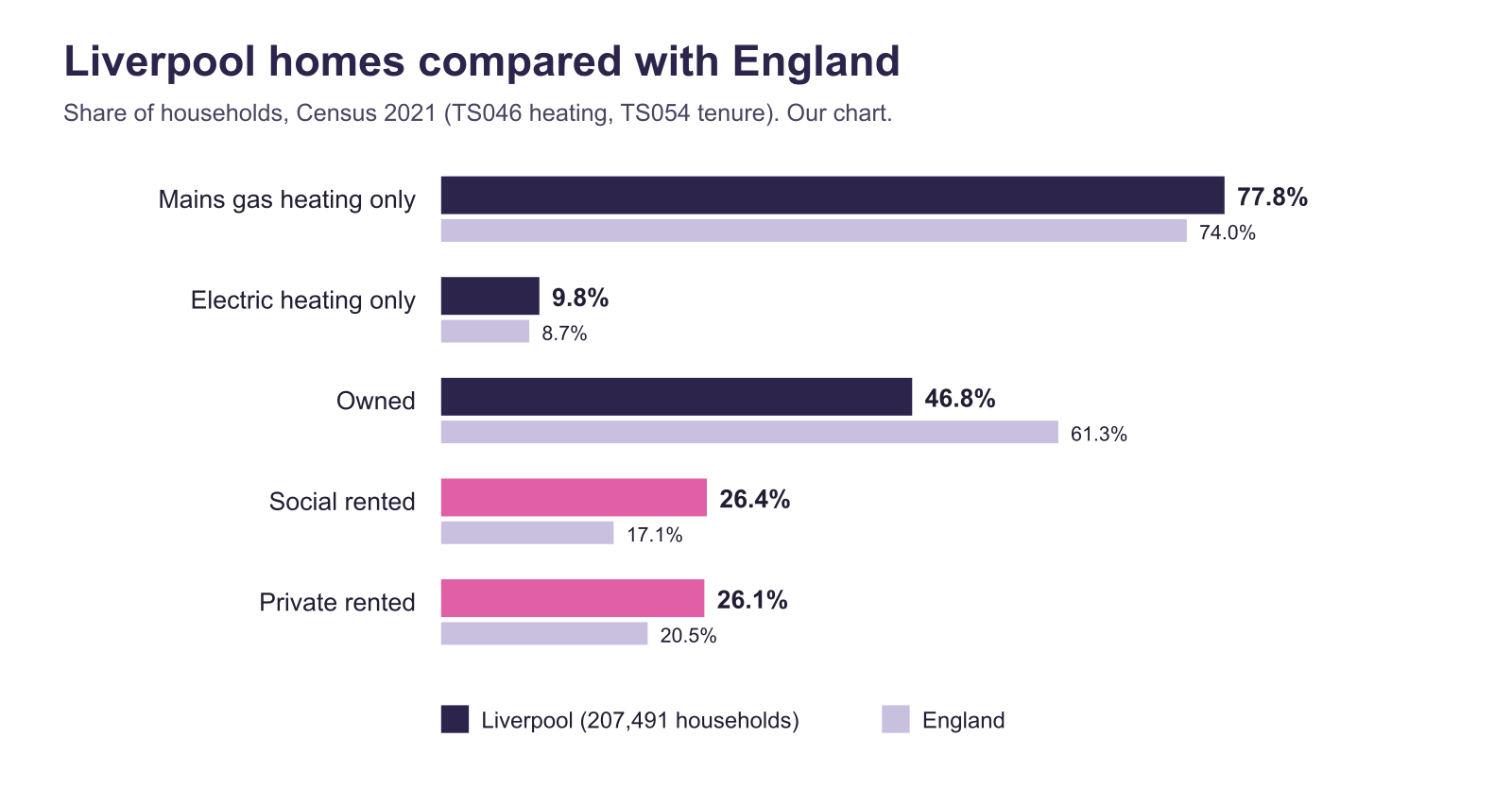
Liverpool is a gas city: 77.8% of its 207,491 households heat with mains gas alone, and more than half rent their home. Whether you're booking a boiler service, letting a flat or worried about a fault, the rules that protect you are the same. This guide sets them out, from the law and HSE's own guidance.
- By law, gas work must be done by a Gas Safe registered engineer.
- Ask for the ID card, and check the categories on the back.
- Landlords: a check every year, a copy within 28 days, records for two years.
- HSE advises servicing gas appliances at least once a year.
The short version
Finding a gas engineer you can trust in Liverpool
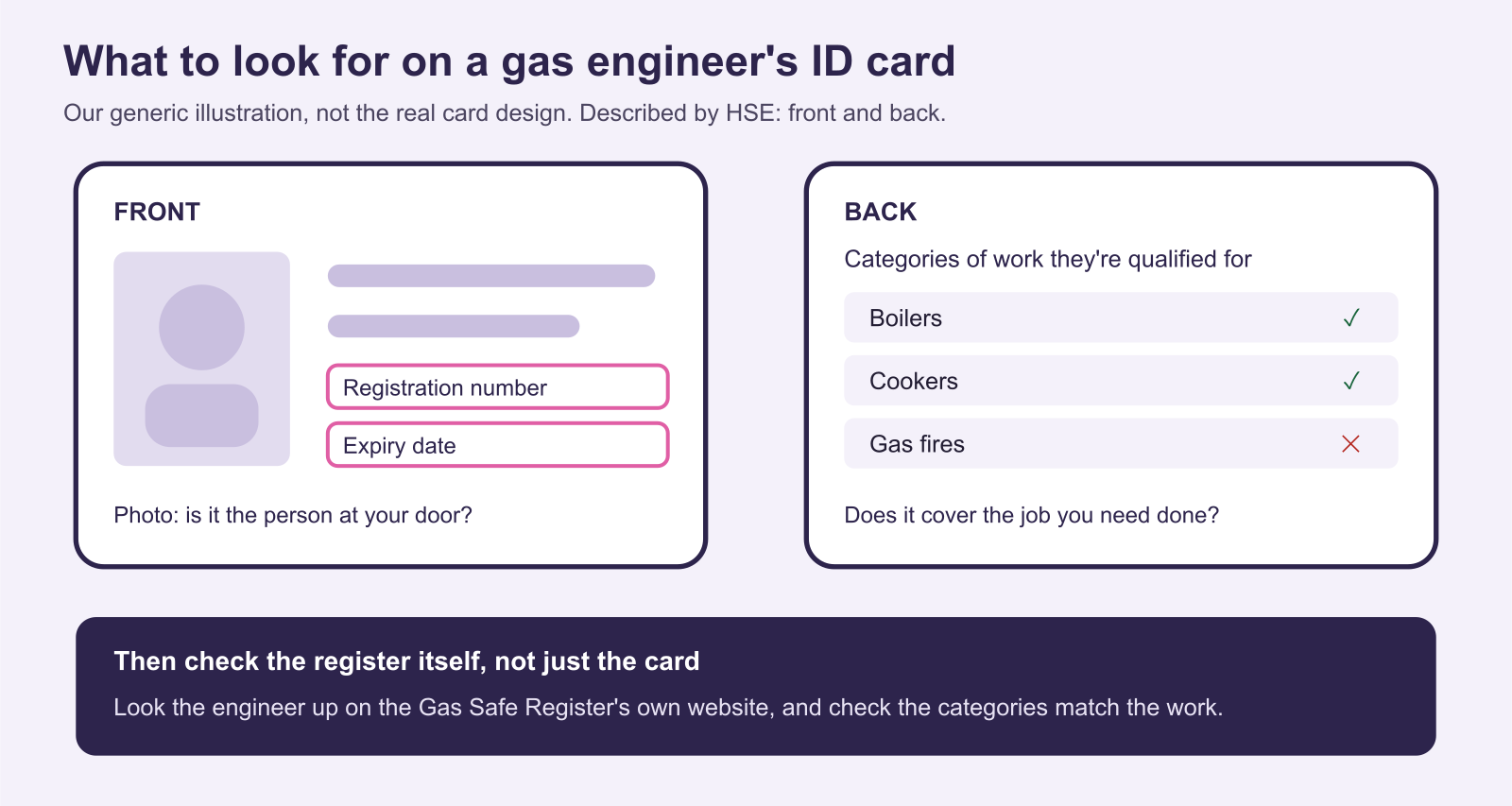
In short: any engineer who works on gas in your home must, by law, be on the Gas Safe Register. HSE explains that under the Gas Safety (Installation and Use) Regulations 1998, a gas business must be registered to do gas work legally. Registered engineers carry an ID card with a photo, a registration number and an expiry date on the front, and the categories of work they're qualified for on the back: boilers, cookers or gas fires, for example.
So two checks matter before anyone starts. Is the person in front of you registered? And is their registration for the kind of work you need? An engineer qualified for boilers isn't automatically qualified for a gas fire. HSE advises checking that the engineer is competent in that specific area of gas work, and the Gas Safe Register's website lets you look an engineer up and confirm the person who arrives is the one you found.
More in checking a Gas Safe engineer and questions to ask before work starts.
Why it matters
What goes wrong when gas work isn't done properly
HSE's figures are blunt: every year around seven people die from carbon monoxide poisoning caused by gas appliances and flues that haven't been properly installed or maintained, or are poorly ventilated. Carbon monoxide has no smell, and early symptoms can be mistaken for flu, food poisoning or tiredness.
Unregistered gas work is illegal, and HSE says it is illegal for anyone to use a gas appliance they suspect is unsafe. When an engineer finds an appliance either "at risk" or "immediately dangerous", the warning label says the same thing: Danger, Do Not Use.
See carbon monoxide safety, gas fires and flues and cookers and hobs.
For landlords
When is your next gas safety check due?
Enter the date of the last gas safety check and see the next deadline, the two-month early window, and the dates for tenants' copies and record keeping. Based on HSE's guidance; works in your browser and sends nothing.
Use the date on the last gas safety record. The tool works out the next deadline, the early window, and the dates for tenants' copies and record keeping.
Enter the date of the last check.
- Next check due by
- –
- Early window opens
- –
- Tenants' copy was due by
- –
- Keep that record until at least
- –
Dates from HSE's guidance on landlords' duties. This is a reminder tool, not legal advice; the record itself and HSE's guidance are what count. Nothing you enter is sent anywhere.
Renting in Liverpool
Landlords' gas safety duties
Renting is unusually common in Liverpool: Census 2021 shows 26.1% of households renting privately and 26.4% from a council or housing association, against 20.5% and 17.1% across England. That makes landlords' gas duties relevant to most streets in the city.
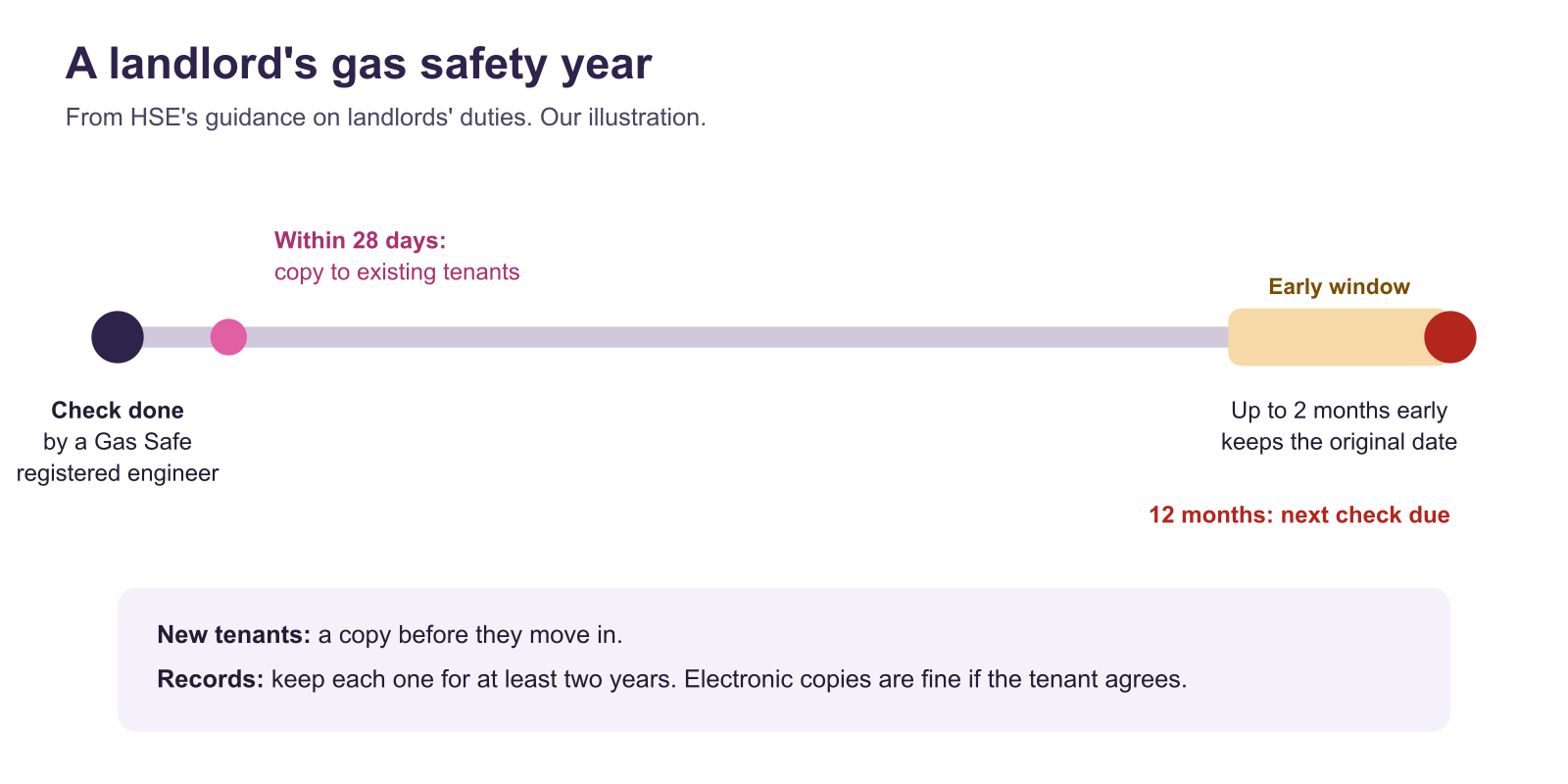
HSE's guidance is clear. A landlord must have every gas appliance and flue it provides checked every year by a Gas Safe registered engineer. Existing tenants must get a copy of the record within 28 days of the check; new tenants before they move in. Records must be kept for at least two years. Under a 2018 change, a check done up to two months before the deadline can keep the original deadline date, provided the landlord can show the records.
Lodgers count too: if someone pays you rent to live in your home, you're classed as a landlord. See landlord gas safety and reading a gas safety record.
Liverpool figures
How Liverpool homes compare
| Liverpool | England | |
|---|---|---|
| Mains gas heating only | 77.8% | 74.0% |
| Electric heating only | 9.8% | 8.7% |
| Oil heating only | 0.1% | 3.2% |
| No central heating | 2.3% | 1.5% |
| Rented privately | 26.1% | 20.5% |
| Rented socially | 26.4% | 17.1% |
Nomis, Census 2021 tables TS046 and TS054. See Liverpool homes and heating.
Boilers
Servicing, repair or replacement
HSE strongly advises that all gas appliances, flues and pipework are installed, regularly maintained and serviced at least annually by a Gas Safe registered engineer. For owner-occupiers that's advice rather than law, but manufacturers' warranties often depend on it, and a serviced boiler is easier to keep running.
When a boiler fails, the repair-or-replace decision depends on the fault, the boiler's age and parts, and how long you plan to stay. Gas boilers are charged VAT at the standard rate, and there's no government grant towards them: the Boiler Upgrade Scheme pays towards heat pumps, not boilers. See boiler servicing, repair or replace and gas boiler or heat pump.
Paying for gas work
Think of safety checks as part of running the home
A gas safety check or a service is easy to see as a bill with nothing to show for it. It's better thought of as part of what a gas-heated home costs to run safely, like insurance: the cost is predictable, and the alternative, an appliance that fails in winter or a carbon monoxide leak, is not.
For landlords, the annual check is a legal duty, and it's cheaper to plan than to chase. For owners, an annual service is the way to keep a warranty valid and catch faults early. Either way, the engineer must be Gas Safe registered for the appliance in question.
Safety first
If you smell gas, or an alarm goes off
Gas smell: call the gas emergency number, 0800 111 999, open all doors and windows, and shut off the supply at the meter control valve if you know where it is.
Carbon monoxide alarm or symptoms: stop using gas appliances, get fresh air, and seek urgent medical advice from your GP or A&E if anyone feels unwell.
See smell gas: what to do and who to call for problems that aren't emergencies. For tenants, see your rights and moving in; for buyers, buying a home with a gas boiler.
Gas engineer questions
How do I know a gas engineer in Liverpool is legal?
By law, anyone doing gas work in your home must be on the Gas Safe Register. Ask to see their ID card, check the photo, registration number, expiry date and the categories of work on the back, then look them up on the Gas Safe Register’s website.
Do landlords in Liverpool need a gas safety certificate?
Landlords must have every gas appliance and flue they provide checked every year by a Gas Safe registered engineer, give existing tenants a copy of the record within 28 days and new tenants a copy before they move in, and keep records for at least two years.
How often should a boiler be serviced?
HSE strongly advises that gas appliances, flues and pipework are serviced at least annually by a Gas Safe registered engineer. Your boiler’s manual and warranty may set their own conditions.
What should I do if I smell gas?
Call the gas emergency number, 0800 111 999, open all doors and windows, and shut off the gas at the meter control valve if you know where it is. Don’t use a gas appliance you suspect is unsafe.
Do I need a carbon monoxide alarm?
In rented homes in England, since 1 October 2022 landlords must fit a carbon monoxide alarm in any room used as living accommodation with a fixed combustion appliance, excluding gas cookers. For everyone, an alarm is a sensible precaution.
Does this site recommend gas engineers?
No. Liverpool Gas Engineer Guide is an independent guide published by SEO-DONS LTD. It doesn’t do gas work, rank engineers or pass your details on.
This guide
What this guide is, and isn’t
Liverpool Gas Engineer Guide is an independent guide published by SEO-DONS LTD. It doesn't do gas work, isn't on the Gas Safe Register and doesn't recommend engineers. It explains the rules so you can check whoever does the work, and points you to HSE, the Gas Safe Register and GOV.UK for the official word.
Sources used on this page
- Domestic gas: frequently asked questions · HSE (3 November 2026)
- Gas Safe Register and the engineer ID card · HSE (3 November 2026)
- Landlords’ responsibility for gas safety · HSE (3 November 2026)
- Gas safety check records and what to keep · HSE (3 November 2026)
- Gas safety checks: who needs them · HSE (3 November 2026)
- Carbon monoxide poisoning · HSE (3 November 2026)
- Gas Safety (Installation and Use) Regulations 1998, regulation 36 · legislation.gov.uk (3 November 2026)
- Smoke and Carbon Monoxide Alarm (Amendment) Regulations 2022: guidance · GOV.UK (3 November 2026)
- Census 2021 TS046, central heating, Liverpool and England · Nomis (3 November 2026)
- Census 2021 TS054, tenure, Liverpool and England · Nomis (3 November 2026)
- Boiler Upgrade Scheme: what you can get · GOV.UK (3 November 2026)
- VAT Notice 708/6, energy-saving materials and heating equipment · HMRC (3 November 2026)
A question about gas work in your home?
Tell us what you're trying to sort out. Your message reaches SEO-DONS LTD, the publisher of this guide, and we answer by email. We don't do gas work or recommend engineers, but we can tell you what to check and where. If you smell gas, don't write to us: call 0800 111 999 now.
What happens next
- Your message reaches SEO-DONS LTD, which publishes this guide.
- We reply by email with the rule or check that applies.
- Any work is between you and a Gas Safe registered engineer you choose.